UUID v4 in Practice: Choosing, Generating, and Storing Unique IDs
Learn what UUID v4 is good for, how to generate identifiers safely, and how to store them without confusing uniqueness with authorization.
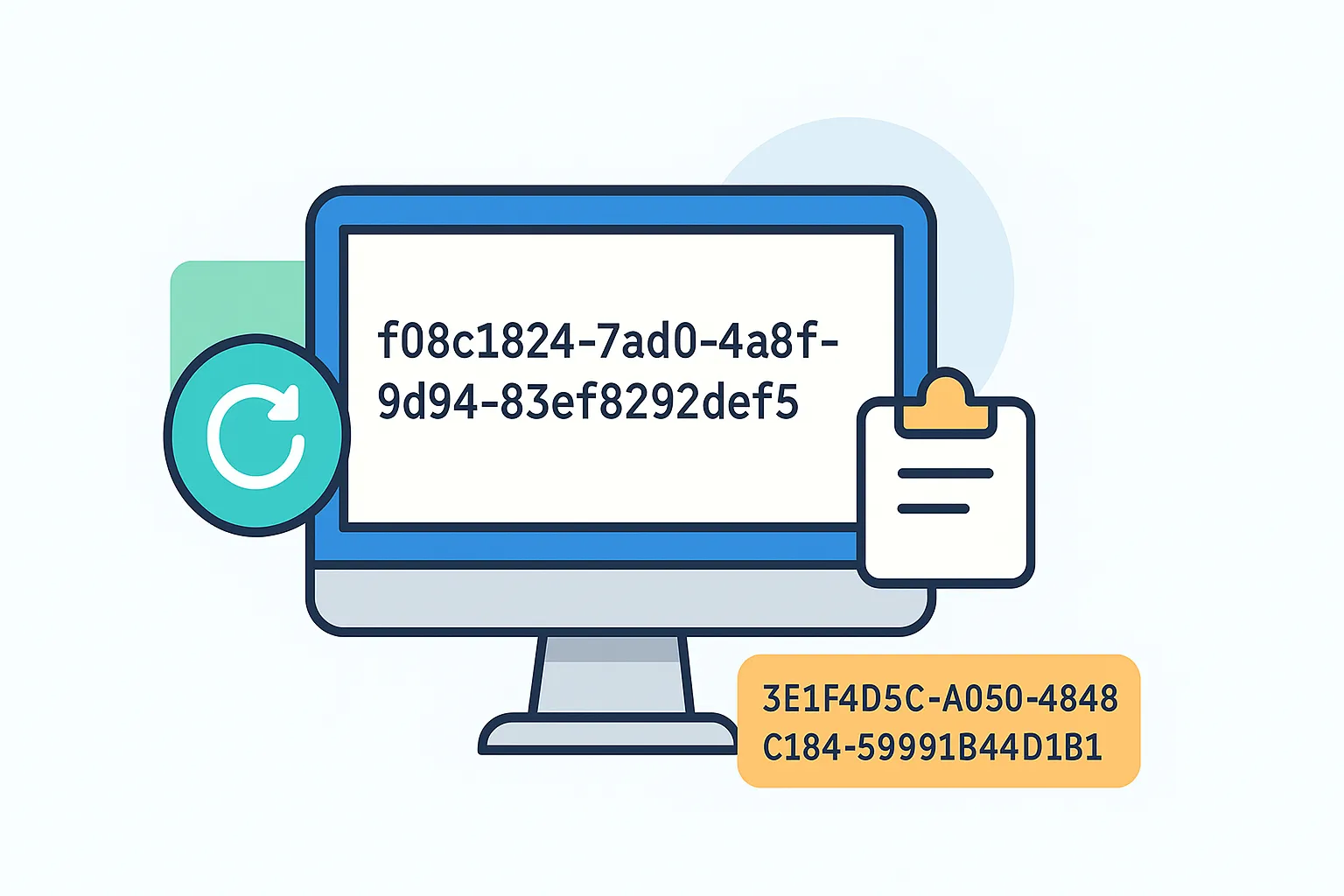
When records need identifiers that can be created independently across services, a UUID can be a practical choice. IT Market Plus lists its UUID Generator among its featured developer utilities and popular tools. It generates UUID v4 and NIL identifiers, supports bulk output, and offers case and hyphen options.

What a UUID v4 provides
A UUID is a 128-bit identifier commonly written as five hexadecimal groups, such as xxxxxxxx-xxxx-4xxx-yxxx-xxxxxxxxxxxx. Version 4 values are generated from random or pseudorandom bits, with fixed version and variant bits in the standard representation. Their large space makes accidental collisions extremely unlikely for typical application workloads, but no random identifier should be treated as mathematically impossible to duplicate.
Generate IDs at the right boundary
Generate an identifier once when a record is created, then keep it stable for that record's lifetime. If multiple services create records independently, a UUID can avoid requiring one central counter. For web applications, use a cryptographically strong random source provided by the platform; avoid hand-written recipes based on Math.random() for identifiers that need strong unpredictability.
Use the IT Market Plus UUID Generator to create one or many values, then copy the output into a development fixture or workflow. Treat generated values as identifiers, not as credentials: a UUID by itself should not grant access to a user account, private file, or privileged operation.
Store and validate consistently
- Pick one canonical format, usually lowercase with hyphens, and use it consistently across APIs and logs.
- Validate the expected shape at input boundaries, and reject malformed values before database lookups.
- Choose a database type or text representation that matches your stack, then index identifiers used for lookups.
- Keep authorization checks separate. Knowing a record's UUID must not be enough to read or modify it.
- Do not regenerate an ID when retrying an operation if doing so could create a duplicate record; use an idempotency strategy appropriate to the workflow.
UUIDs are not always the best key
UUIDs are longer than compact integer keys and can be less locality-friendly in some database indexes. If a system needs sortable IDs, smaller URLs, or a database-specific key format, compare alternatives against the actual workload and compatibility requirements. Avoid exposing identifiers as secret tokens, and never place private data inside an ID.
A quick workflow
- Decide whether independent generation or opaque identifiers are useful for the feature.
- Generate a UUID v4 with a cryptographically strong generator.
- Store it once, enforce uniqueness in the database, and preserve it across retries.
- Apply authentication and authorization checks separately from identifier validation.
- Test serialization, casing, and lookup behavior between every service that handles the ID.
For a small prototype or test dataset, the IT Market Plus UUID Generator provides a quick way to create UUID v4 values in bulk. For production systems, generate identifiers in the application or service that owns record creation and keep the generator's security and persistence behavior under your control.
Platform Administrator
Lead software architect and site administrator for IT Market Plus.